

Project details
Status: Current
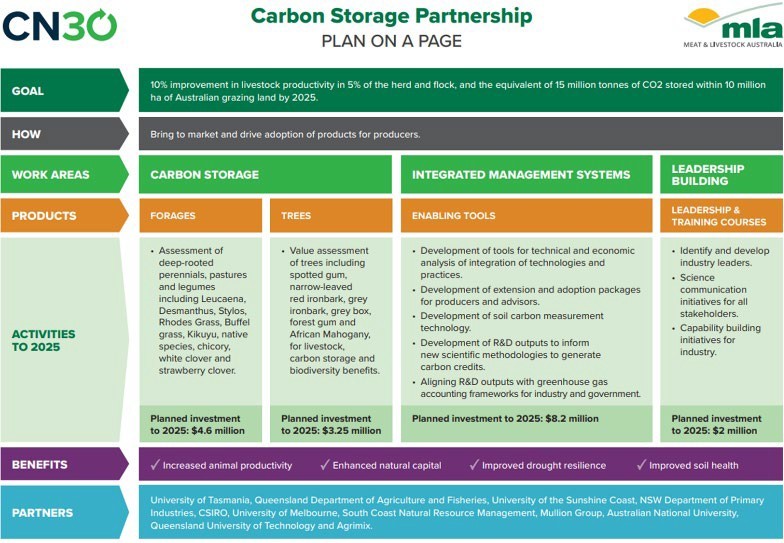
The Carbon Storage Partnership (CSP) is an initiative of Meat & Livestock Australia (MLA) that aims to build the capability and capacity of Australia's livestock sector to become carbon neutral by 2030 (CN30).
The multi-million-dollar Partnership is led by Professor Matthew Harrison at Tasmanian Institute of Agriculture (TIA), and brings together a range of research, industry and government partners to develop the skills, technologies and practices needed to achieve the CN30 goal.
Supporting producers learn about carbon neutrality
A key focus of the Partnership is assisting and supporting producers to learn about the opportunities for carbon neutrality, and developing a pathway that is profitable, environmentally sustainable and socially acceptable.
In Australia, agriculture contributes approximately 13% of the total greenhouse gas (GHG) emissions, the third biggest sector followed by Stationary Energy and Transport (DISER 2020). About 68% of the agricultural sector's emissions are methane produced by ruminant digestion of cows and other livestock, with a further 10% from manure management processes.
The CSP is working towards the following outcomes:
- A 10% improvement in livestock productivity in 5% of the herd and flock, and the equivalent of 15 Mt of CO2 stored within 10 M ha of Australian grazing land by 2025.
- Providing producers opportunities such as:
- Understanding GHG emissions on-farm and opportunities for generating carbon credits to diversify income streams.
- Adopting promising new technologies for increasing carbon storage at scale in a profitable way.
- Contributing improved management practices and skills for improved environmental outcomes on farm.
- Learning from other producers and get involved through workshops, field days and other interactive sessions.
Research projects funded under the CSP include:
- Sustainable Pathways to CN30 (Tasmanian Institute of Agriculture)
- Data platform for increasing soil carbon in Australian agricultural systems (Agrimix / Queensland University of Technology)
- Time controlled grazing for soil C sequestration and improved ecosystem services (Queensland University of Technology)
- Maximising co-benefits of trees on farm (University of Melbourne)
- Steak ‘n wood: demonstrating livestock productivity and environmental service benefits of trees on farm in northern systems (Queensland Department of Agriculture and Fisheries)
- Hyperspectral remote sensing of soil organic carbon (Perennial)
Related resources
Browse fact sheets and project updates below.
Farm revegetation has substantial potential to improve biodiversity outcomes
The research team apply a habitat-based biodiversity assessment approach to examine the potential for grazing farms across Australia to improve outcomes for biodiversity by revegetating 10 % of the farm area. It includes 14 case study farms across Australia.
Grazing management for soil carbon in Australia: A review
This review examined how livestock grazing management (e.g. animal densities and duration of grazing), as well as fertiliser, pasture species, soil type, climate and other forms of farm management impacted on soil carbon gain or loss
Operationalising net-zero with biochar: black gold or red herring?
This work explores implications associated with feeding biochar to cattle for greenhouse gas emissions, profitability, soil carbon and social licence to operate.
Clarifying confusions over carbon conclusions
This paper examines how initial soil carbon stocks influence gains or losses in carbon following management practice change. The paper shows the influence of soil texture, climate, management, fertilizer, crop type, sowing time, genotype and other factors on rate of change of soil carbon over time (sequestration).
How to fix Australia’s approach to soil carbon credits so they really count towards our climate goals
This Conversation piece problems associated with the Australian Government’s approach to crediting landholders for gains in soil carbon. Several suggestions for improvement are offered.
Costs of transitioning to net zero under future climates
This original research article explores economic and biophysical costs associated with implementing pathways towards net zero (genetic, agronomic, environmental, engineering, agroecological).
Advancing place-based crop modelling for global adaptation to crop waterlogging
This research demonstrates how advances in modelling analytics can be used to adapt to and overcome crop waterlogging. Multiple forms of adaptation to waterlogging are proposed (agronomic, crop genetics, engineering).
Cattle, cash, carbon and the climate crisis
This work examines the interplay between greenhouse gas emissions mitigation and climate change adaptation, together with implications for costs, food security and environmental stewardship.
Costs of transitioning the livestock sector to net-zero emissions under future climates
Land managers are challenged with the need to balance priorities in production,
greenhouse gas (GHG) abatement, biodiversity and social license to
operate. Here, we develop a transdisciplinary approach for prioritising land
use, illustrated by co-designing pathways for transitioning farming systems to
net-zero emissions.
'Care' of country: Grazing management and sense of place
In the semi-arid rangelands of southern Australia livestock producers must balance livestock production with landscape function to achieve business resilience. Under highly variable climatic conditions, their approach to grazing management is a key element in achieving production and landscape targets.
Planting trees on farm: implications for biodiversity and natural capital (webinar)
Professor Matt Harrison was a speaker in this webinar which provided an outline of the Carbon Storage Partnership, the impacts of planting trees on farm on carbon, biodiversity and natural capital and other related issues
Climate-smart farming: protecting land, securing the future
This video provides an overview of the farm management practices that a Tasmanian farmer has used to adapt to seasonal climate variability and improve drought resilience while maintaining environmental stewardship
Regenerative agriculture: food, profit, emissions
This video provides a simple introduction to regenerative agriculture. It explains the main practices involved, such as cell and rotational grazing, silvopastoral systems, agroforestry, minimal soil disturbance, reduced use of synthetic fertilisers, herbicides and pesticides, and greater diversity in farming systems.
Can grazing management increase soil carbon? (webinar)
This video describes findings from an extensive literature review on the impacts of grazing and farm management on soil carbon.
Biochar as a feed supplement: implications for profit, carbon and sustainability (webinar)
This webinar showcases experimental results from research conducted on a commercial farm in Tasmania, where cattle were allowed ad libitum (free) access to feed-grade biochar.
Costs of transitioning to net zero under future climates
This video discusses the costs of transitioning farming systems to net-zero emissions and associated topics.
Carbon cycling 101 and climate change
This video provides an overview of carbon cycling and pathways for reducing carbon.
Carbon and biodiversity markets associated with planting trees
This video describes introductory principles and opportunities for landholders to participate in carbon and/or biodiversity markets associated with planting trees on farm.
Rethinking global warming from methane: GWP* vs GWP100
Renowned US-scientist Professor Mitloehner was invited by the Tasmanian Institute of Agriculture to deliver a presentation on rethinking global warming.
Soil carbon markets: science or snake-oil?
This video breaks down the hype about soil carbon.
Pathways to net-zero emissions
This video covers pathways to carbon neutral (or net zero) agricultural systems.
Grazing management and soil carbon
This factsheet address the question 'can grazing management improve soil organic carbon?'
Farmers have a lot on their plates maintaining profitability, while juggling other emerging challenges like climate change, greenhouse gas (GHG) emission reduction and biodiversity. The need for innovations that boost productivity, profitability and biodiversity while slashing GHG emissions has never been higher.
Reducing emissions in the rangelands
This article discusses optimal interventions for rangeland producers to reduce their emissions without compromising profit, productivity or biodiversity habitat.
Related stories
For more information contact:
Acknowledgements:
The Carbon Storage Partnership (CSP) is an initiative of Meat & Livestock Australia (MLA) that aims to build the capability and capacity of Australia's livestock sector to become carbon neutral by 2030 (CN30).